Hey everyone! Today, I am going to show you a super cool application of what I introduced to everyone earlier – annihilation reaction. The Casimir effect is a small attractive force that acts between two close parallel uncharged conducting plates, due to quantum vacuum fluctuations of the electromagnetic field, blah, blah, blahhhh.. OK, wake up, don’t fall asleep just yet! Forget the textbook definition, let’s dive straight into a simple and complete breakdown of the Casimir effect that I have prepared just for you folks!
Heisenberg’s Uncertainty Principle states that you cannot measure the position and the momentum of a particle at the same time. You can only measure one at a time.
In Casimir effect, we talk in terms of time and energy of a particle at the same time. For example take a photon: you can measure the time at which it comes to a position, but the cost of that measurement is the you cannot measure the energy of the photon at that position and vice versa.
This uncertainty principle also suggest that a photon with zero energy, which practically means it doesn’t exist, can suddenly acquire energy, making its energy state uncertain.
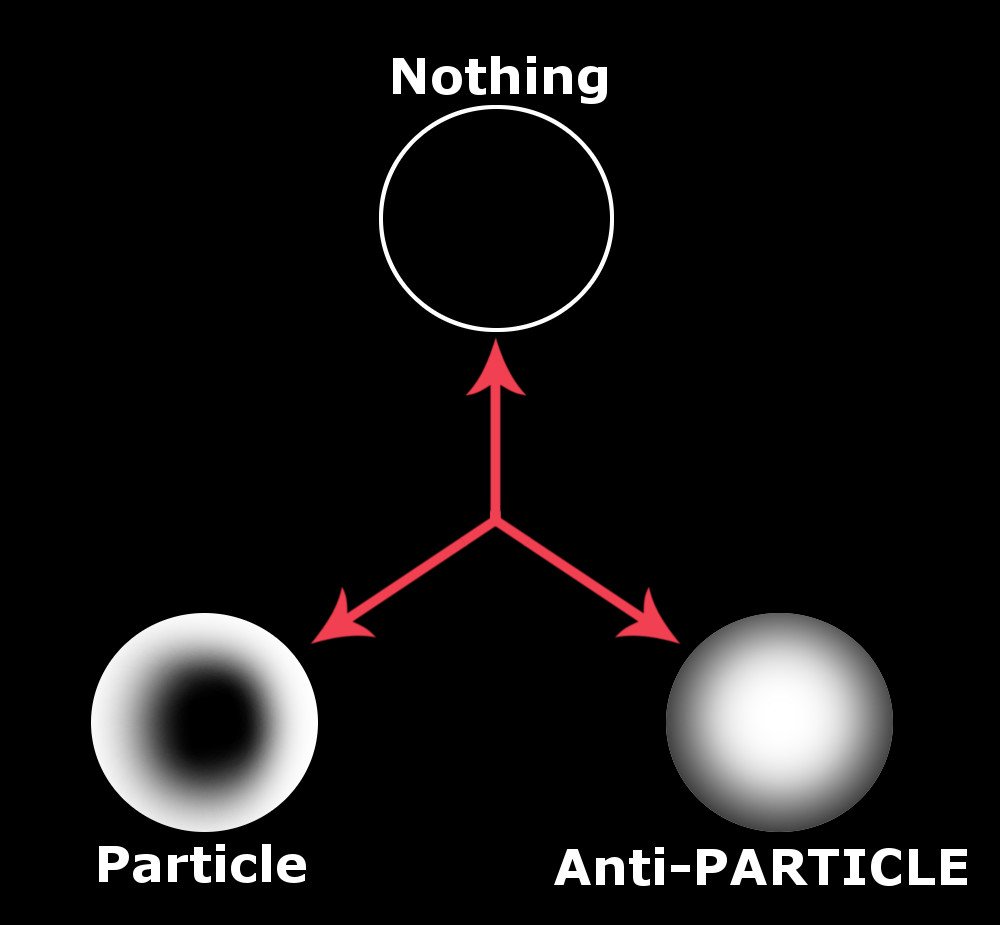
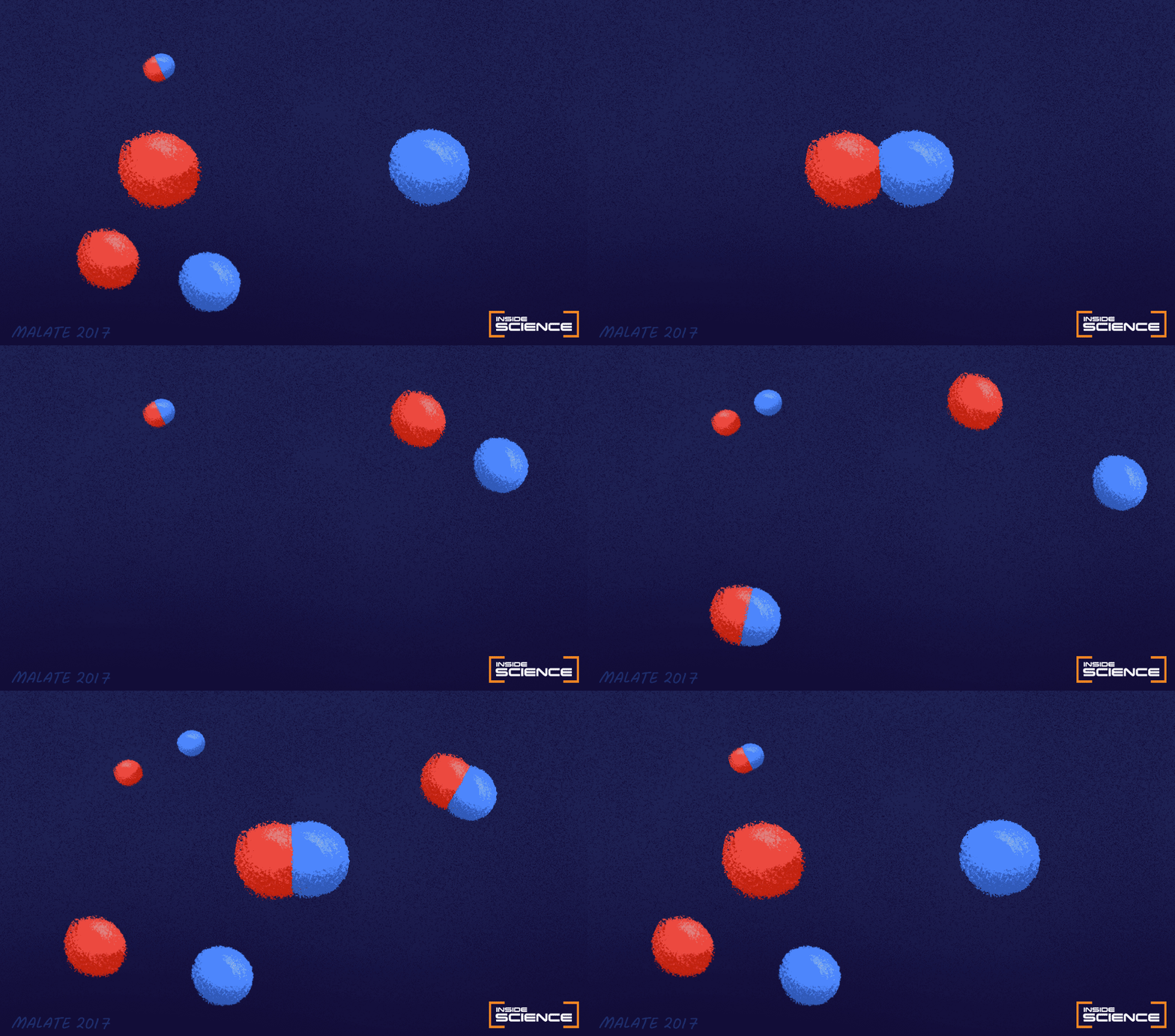
Now we all probably learnt in our physics classes that vacuums are empty space, and there are no particles in a vacuum. However, this is technically wrong. There are virtual particles popping in, and out of existence, through annihilation reaction in a short span of time, but we just can’t detect them directly.
How is this possible? I will make this easier to understand using an analogy. Imagine that you are in a carnival, and you want to ride the carousel. However, you left your wallet at home. In order to buy a ticket for one round, you need 5 dollars. You approach the ticket counter, taking your chances, and explain your dire need of 5 dollars to the staff woman there, to go on the ride. The woman, feeling bad, loans you the five dollars, and she makes you promise that you will repay her within the next 30 minutes. You take the money, buy a ticket and go for one round. You repay her within the next thirty minutes, and the debt is repaid, making the staff woman’s money deficit balanced.
But the carousel ride was so fun that you want to go five more times in a go! You go back to the woman and ask her to give you 25 dollars. She frowns at you, and tells you that she will give you the money, as long as you repay her within 10 minutes this time!
Now let’s make the connections. You are the particle, the system is the staff woman, and the money is the energy required. A particle can pop into existence by borrowing energy from a system, as long as it puts the energy back before anyone notices, which is basically through annihilation. The more energy you borrow, the less time you have to put it back. This is a type of time-energy tradeoff that occurs in a vacuum.
There are still some rules that must be followed, though. These particles can only be produced in pairs, more specifically, in the form of particle-antiparticle pairs. So, in a vacuum there is a vast mass of pairs of particles-antiparticles popping into existence and disappearing, and so they are all considered virtual particles (more about the exact definition later). Also, any particle-antiparticle pair can be produced such as photon-photon, electron-positron etc. But the least energy are required by photon-photon pairs, because photons are the least massive particles. If we look at the Einstein’s famous equation e=mc^2, where m stands for mass and e stands for energy, we can justify that the more massive your particle is, more energy is required.
Now that you know the basics, let’s come to the Casimir effect. In this experiment, scientist Hendrik Casimir in 1948, predicted that two metal plates can attract each other in a vacuum, if they are placed a micrometer apart – 0.000001 m apart – they would shift and attract each other. Sounds bizarre right? Remember that these plates are not connected to any external power sources, to create magnetic fields and attract from there or anything.
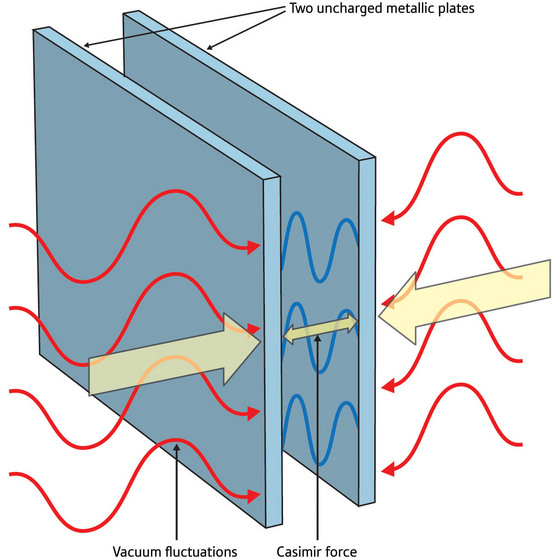
Ok, before I make your head hurt, let’s break this seemingly complex phenomena down a bit, shall we? When you place the plates so close together, you create restrictions in the space between the plates, and so you create restrictions in the types of (low-energy) photons you can produce, whilst the photon pairs on the other sides of both the plates, have virtually no restrictions. So the photon pairs produced within the gap have small wavelengths, because that’s all the size they can squeeze in, and so you create fewer particles compared to the other sides of the two plates. So the more photons created in the vacuum on the exposed sides of the plates exert a pressure on the plates as the bounce around, and so do the photons in the gap. But since there are more photons on the outside, they exert more force compared to the photons in the gap, overpowering them, and pushing the plates closer together! There are lots of other factors at play here like energy density of space time etc, but all that for another day 😉
Theoretically, you could actually produce any pairs of objects you wanted to like houses or cats or planets. But the problem is, their masses would be so huge that by the time they pop into existence, they annihilate and dissapear so quickly, that you don’t even see them (recall the time-energy tradeoff I introduced you to earlier)! So, we don’t bother to look at the macroscopic version of this phenomena created by Heisenberg’s Uncertainty Principle.
So there you have it – Casimir effect in a nutshell. Hope I didn’t confuse anyone too much! If you survived reading through this explanation, congratulations and kudos to you, for you have learnt the mechanics of one of the many perplexing events fresh from the world of physics, that you probably never heard of before!
Give me a like and comment if you liked this post! Oh, and subscribe to my blog, if you would like to get notified every time I post a new explanation!
Have a great day ahead and keep loving learning!
 Quantum Effects
Good one. Explained in a simple way. Keep going.
LikeLiked by 1 person
Thanks ma’am 🙂
LikeLiked by 1 person
Nice explanation made easy to understand complex phenomenon.
LikeLiked by 1 person
Thank you very much sir.
LikeLiked by 1 person