Quantum computing is the new future of information technology. Mighty and possibly revolutionary, these computers will be a force to reckon with within a few decades down the line. Google’s quantum computer, called ‘Sycamore’, was able to solve a specific problem in a 200 seconds, while estimating a powerful supercomputer would take a whopping 10,000 years to perform the same task. Quantum computing is holding high promise of becoming the ‘Belle of the Ball’, taking digital computation and problem-solving capacities to a level we never would have thought possible.

All right. Enough with the majestic introduction. You probably must be thinking of something along the lines of: “Why does she just add ‘quantum’ in front of every word in the dictionary?” or “Does this mean I can finish my maths homework quicker, with this computer?”. Unfortunately, I don’t really have the best answers for those kind of queries. But, I can give you an idea as to what these kind of computers can do, how they work, and the promises they hold for the world in the future.
The computer we use in our day to day lives is a very average computer. It functions based on the binary system, using ‘bits’. Bits can exist as either 0’s or 1’s. There is a lot more certainty in regular bits, as we are very sure of the state of the bit (either 0 or 1).
However quantum computers have a weird unit of information. They use qubits (quantum bits). Other than the fact that I have yet again added the word ‘quantum’ in front of a regular dictionary word, there is something else that makes it different. The qubits can exist as a 0, and as a 1, at the same time. This phenomena is known as superposition, probably the most important concept in quantum computing too. In quantum physics, a particle, such as an electron, can exist in two different states or places at the same time. However, the catch is that, if a measurement is made on the particle, the wave function will collapse (it will return to a single state/place), and there will be no more superposition.
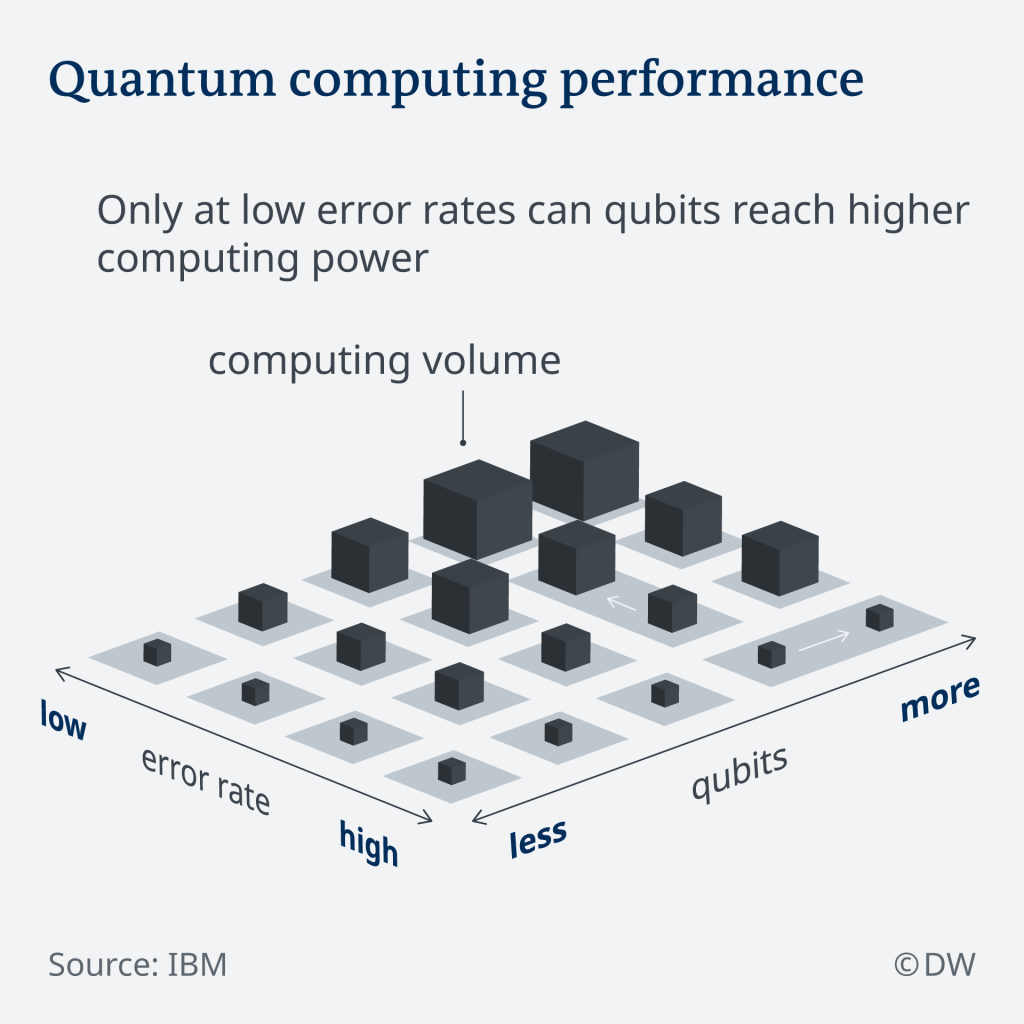
Because of this fragile nature of superposition, the qubits can’t interact with any other particle (which is technically what I meant by ‘measurement’ in the previous paragraph). If it does get disturbed, then the qubit, that was once existing as both 0 and 1 simultaneously, will return to either a 0 or a 1, just like a classic bit from a classical system. As you can see here, we cannot exactly tell which state (0 or 1) it will become if the wave-function collapses. This is because quantum computing, just like quantum physics, is purely based on probabilities. That is what made physicists skeptical about quantum physics in the first place – the lack of certainty. Yes, the risks of loosing the superposition are there. If the qubit interacts with something, it will collapse to either 0 or 1, making the quantum computer not so ‘quantum’. But if there is no disturbance, the system will evolve in a deterministic way and maintain its superposition. The ability to remain quantum over classical is known as quantum coherence.
——————-Interlude for the Mathematics (can skip if wanted)———————-
Interlude: For the mathematically inclined reader, we represent the superposition of 0 and 1 in the form of 𝛂 |0⟩ + β|1⟩, representing the two probabilities or the two states in superposition. If and when a qubit undergoes a measurement, there are 2 possible results with equal chances:
- Result can be ‘0’ with a probability of 𝛂 2
- Result can be ‘1’ with a probability of β2
We get squares of alpha and beta because mathematically, you have to square the wave-function (Ѱ), in order to obtain the probability.

So, now you know how important it is not to make a measurement in superposition, and how it affects the qubit. Let’s discuss a bit about how we ensure that there is no disturbance in the quantum computer. So far, the best developed method of ensuring this is by using superconductors.
A superconductor is basically a special type of material through which a charge can move, without resistance, thereby it does no loose any energy. For example, in electricity cables, there is always some electrical energy lost to the surroundings in the form of thermal energy. This is because of resistance. So, if you have no resistance, then there is no energy lost, hence you get 100% efficiency. But, what does this mean for the qubits? Well qubits are made out of superconductive material such as aluminium, which makes sure there is no resistance. When the qubit moves without resistance, it means that these qubits won’t interact with anything in it’s surroundings = no ‘measurement’ made! Are you able to make the connections?
Here is where things get really sciencey and more detailed (you have been warned)
These qubits are in solid state, and they are made of superconductors (I hope that you understood that). These superconductors will prevent electrons from (a) interacting with each other and (b) interacting with other “degrees of freedom” which are basically other particles in the material such as phonons. These superconductors do this by condensing these electrons into Cooper Pairs. Cooper pairs are pairs loosely bound electrons, which have same speed, but have opposite spin and try to move in opposite directions. These cooper pairs will condense again and form something called an electron superfluid. Superfluids in general, move with no resistance or interactions.
So one mission accomplished – the electrons are far away enough to not interact with each other. Secondly, as there is not enough energy available to break the cooper pair and free the electrons, there will not be any interaction between electrons and the “other degrees of freedom” / other particles present. So second mission is accomplished as well! We can drive the qubit using the electron superfluid, without breaking the Cooper pair and without jeopardising the quantum coherence!
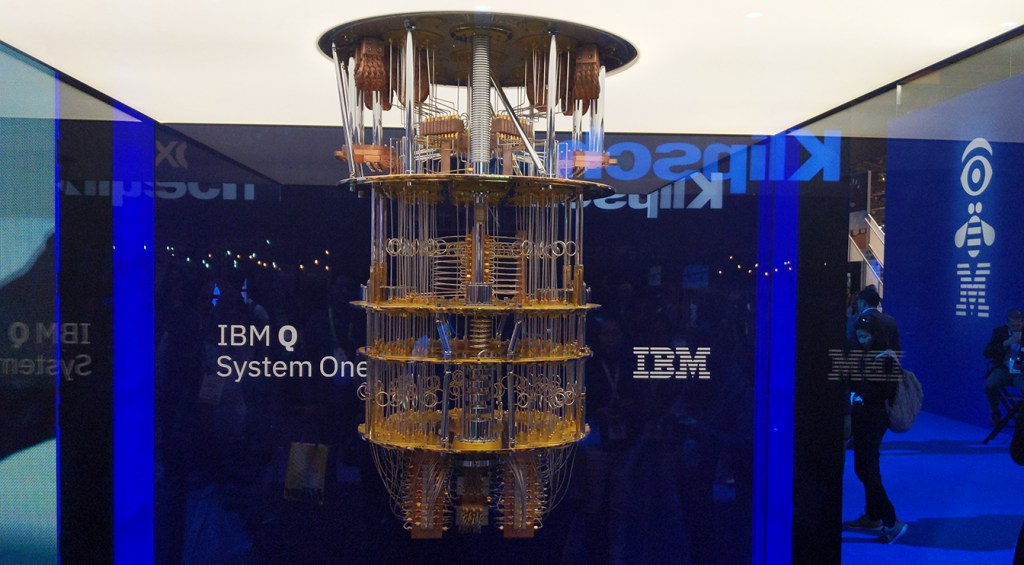
The quantum computer is stored at temperatures near absolute zero (0 Kelvin/-273℃), which is as cold as the vacuum in space. A mixture of two helium isotopes are used. There are a lot more micro processes as well, to eliminate any other sources of error, but I won’t get into to the details.
There are a lot more things going on in quantum computers, then what I have explained. The wave-function of qubits are divided into two components – amplitude(which affects number of Cooper Pairs), and phase value (which affects something called the super-current). Since these are conjugate variables (i.e. they are both related by Heisenberg’s Uncertainty Principle). As I have explained in my previous blogs, this means that these two aspects cannot be measured at the same time, as (yes again) the wave function collapses. So two more qubits under superconductive qubits have been made – charge qubit for the amplitude factor and flux qubit for the phase value factor. If I go beyond this people are going to start fainting, including me.
Quantum computing mainly comes into play when we are faced with large and more complex problems, which regular computers, even supercomputers, don’t have the power to solve. Although quantum computers are mostly used by military for cryptography, physicists are trying to find ways in which to bring these computers to the masses. Currently the only quantum computers are owned by IBM, Google, D-Wave Systems, Toshiba, and a handful of other companies have quantum computers. There is still a long way to go, but the first step is often the most important leap to innovation in the 21st century.
So there you have it! A brief idea of quantum computing! This is just the tip of the ice-berg, there are so so many more things that play pivotal roles in quantum computing. This is the future of technology. Some say it may even be more handy and powerful than artificial intelligence. Who knows? There is always an uncertainty in science, and always scope for improvements. As is there uncertainty in these turbulent times. Seems a lot like quantum physics has predicted the uncertain probability of our future hasn’t it?
Trust me, this is just the beginning.
 Quantum Effects
Very beautifully narrated!
LikeLiked by 1 person
Thank you!
LikeLiked by 1 person